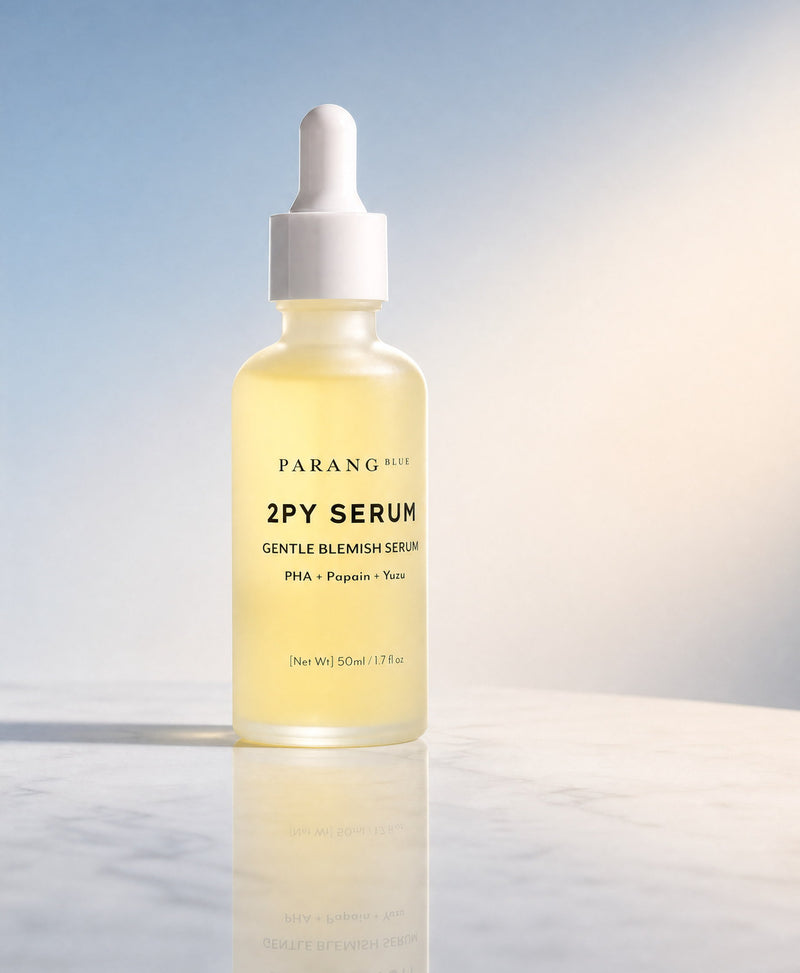
What PHA Is, and Why It Was Chosen Over Stronger Acids for Sensitive Skin
PHA is the exfoliating acid formulators reach for when skin has not done well with the others. What it is, how it compares, and why the 2PY Serum is built on it.
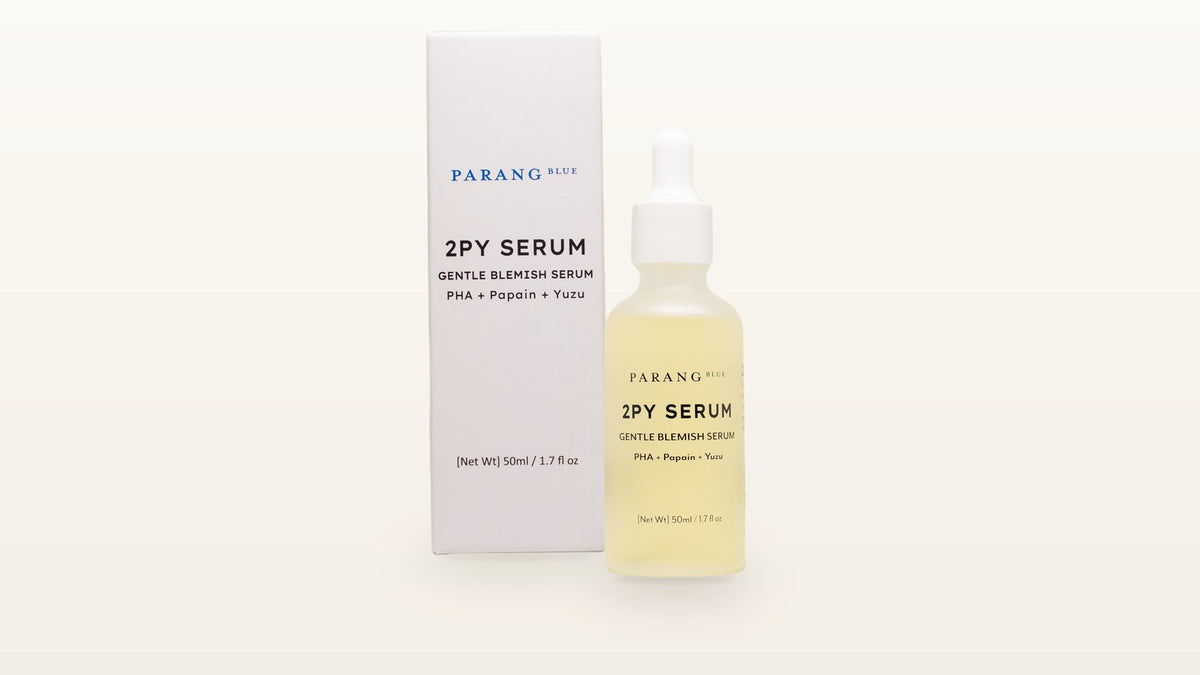
PHA stands for polyhydroxy acid. It is an exfoliating acid from the same broad family as glycolic and lactic acid, and it is the one formulators commonly reach for when a product is meant for skin that has not done well with the others. In the 2PY Serum, PHA does the main work of loosening dull cells at the surface, with papain and yuzu sharing the job.
If you have sensitive skin and a history with exfoliants, you may already know why that matters. This post explains what PHA is, how it differs from the acids you may have tried, and why it ended up at the center of a gentle exfoliating serum.
Exfoliating acids, in plain English
Your skin sheds its outermost layer of cells on its own. Exfoliating ingredients help that process along by loosening the bonds that hold dull, dead cells at the surface. When it works, skin feels smoother. When it is too much, skin feels tight, warm and raw, sometimes for days.
Most exfoliating serums are built on one of three groups of acids.
| Group | Common examples | How it is usually described |
|---|---|---|
| AHA (alpha hydroxy acids) | Glycolic acid, lactic acid | The classic surface exfoliants. Effective, and often too much for reactive skin |
| BHA (beta hydroxy acid) | Salicylic acid | Oil-soluble, used for pores and oily areas |
| PHA (polyhydroxy acids) | Listed on labels simply as PHA, or by individual name | The gentlest of the three. Larger molecules, slower and more gradual at the surface |
That last point is the important one. PHA molecules are generally described as larger than glycolic acid molecules, which is why PHA tends to work more gradually at the surface. For skin that has reacted to faster acids, gradual is the goal.
Why PHA, and not something stronger
The 2PY Serum was built for a specific kind of reader: someone whose skin reacts, who has tried exfoliating products before, and who has the half-full bottles to show for it. For that person, a stronger acid is not an upgrade. It is the reason the last three products ended up in a drawer.
So the choice was never about finding the most powerful exfoliant. It was about finding one that could be used morning and night without the usual two days of tightness afterward. PHA is the acid that fits that brief.
There is a second part to the design. Instead of asking PHA to do all the work at a high level, the formula splits the job three ways:
- PHA, the acid, does the main work of loosening surface cells.
- Papain, the enzyme from papaya, works on a different principle, breaking down the proteins that hold dull cells in place.
- Yuzu, the East Asian citrus, rounds out the exfoliating side of the formula.
Because three ingredients share the work, none of them has to be present at a high level on its own. The 2PY Serum overview covers the rest of the formula.
What sits next to the PHA
An exfoliant on its own is half a formula. The other half of the 2PY Serum is there to keep things calm:
- Centella asiatica, madecassoside and asiaticoside, the cica group, in three forms rather than one
- Allantoin and aloe, two long-standing soothing ingredients
- Panthenol and five peptides, for moisture and the feel of the skin surface
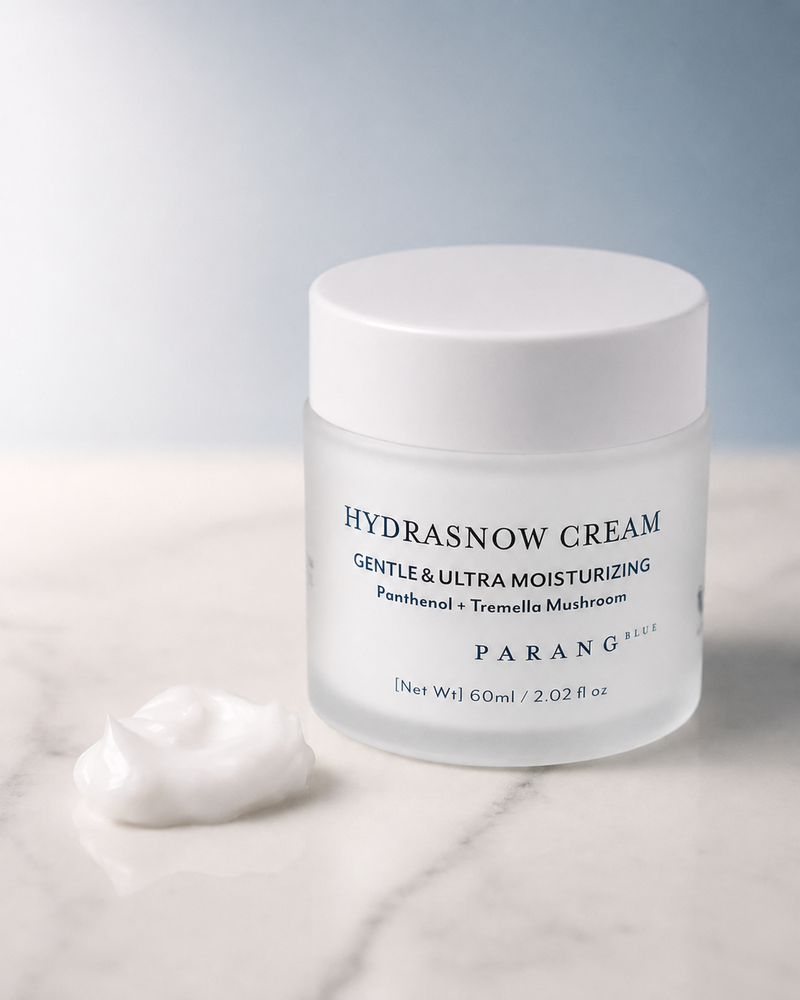
This is the reason an exfoliating serum can sit in a twice-daily routine rather than a twice-weekly one. It is also why it pairs with a moisturizer that contains no exfoliants at all, which we explained in The Two-Step Routine.
How to start with a PHA serum if your skin is reactive
Even a gentle exfoliating serum deserves a careful start.
- Patch test first. Apply a small amount to a small area and wait. The 2PY Serum scored 0.00 in a primary skin irritation patch test (Cert. HM-IR0084-76), but that is a result on a test panel under controlled conditions, not a prediction about your skin.
- Start every other night for the first week if your skin has been reacting lately.
- Press, do not rub. Two or three drops, pressed in with your fingertips.
- Follow with moisturizer while the serum is still slightly damp.
- Wear sunscreen in the morning, as you would with any exfoliating product.
If anything stings, stop.
How to tell an exfoliant is too much for you. Exfoliation that suits your skin is mostly uneventful. Signs that a product is asking too much include:
- Stinging or burning that lasts beyond the first few seconds
- Skin that feels tight, warm or raw for hours afterward
- Patches that start to flake or look shiny and stretched
- Moisturizer or sunscreen that suddenly stings on top
If you notice any of these, stop the exfoliating step and keep the rest of your routine simple until your skin settles. When you go back, go back slower: every other night, or a few times a week, and build up from there. A gentle exfoliating serum is meant to fit into a routine you can keep, not one you have to recover from.
Quick answers
Is PHA the same as AHA?
No, though they are related. Both are exfoliating acids, and PHA belongs to the same broad family as glycolic and lactic acid. PHA is generally described as gentler because its molecules are larger and it works more gradually at the surface.
Can I use a PHA serum every day?
The 2PY Serum was formulated for morning and night use. If your skin is in a reactive stretch, start every other night and build up. Nothing in the formula depends on daily use to work.
Should I use a PHA serum with other exfoliants?
We would not stack it with other acid or enzyme products, especially on sensitive skin. The 2PY Serum already combines PHA, papain and yuzu, so adding another exfoliant means more variables and more chance of overdoing it.
Try it
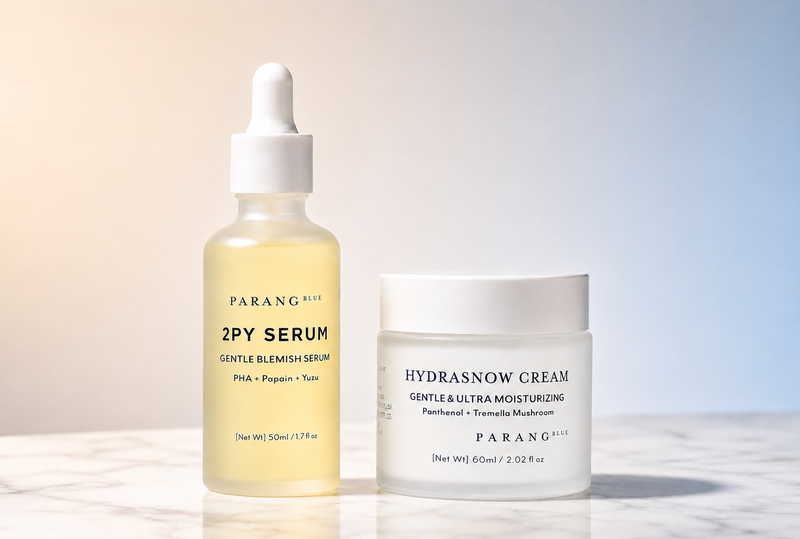
The 2PY Serum is $19.95 for 50 ml. Or get it with the Hydrasnow Cream in The Two-Step Set for $35.90.