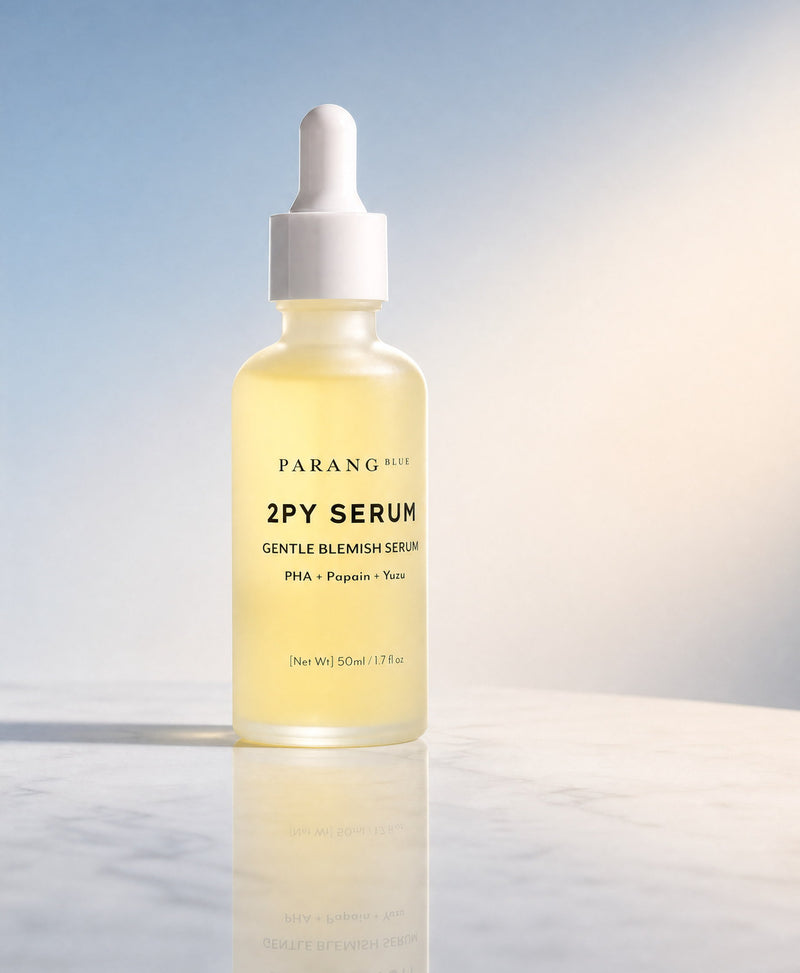
Papain and Yuzu: The Enzyme and Citrus Side of the 2PY Serum
Papain is the enzyme from papaya and yuzu is an East Asian citrus. Here is what each does in the 2PY Serum, and why an enzyme and a citrus sit next to a gentle acid.
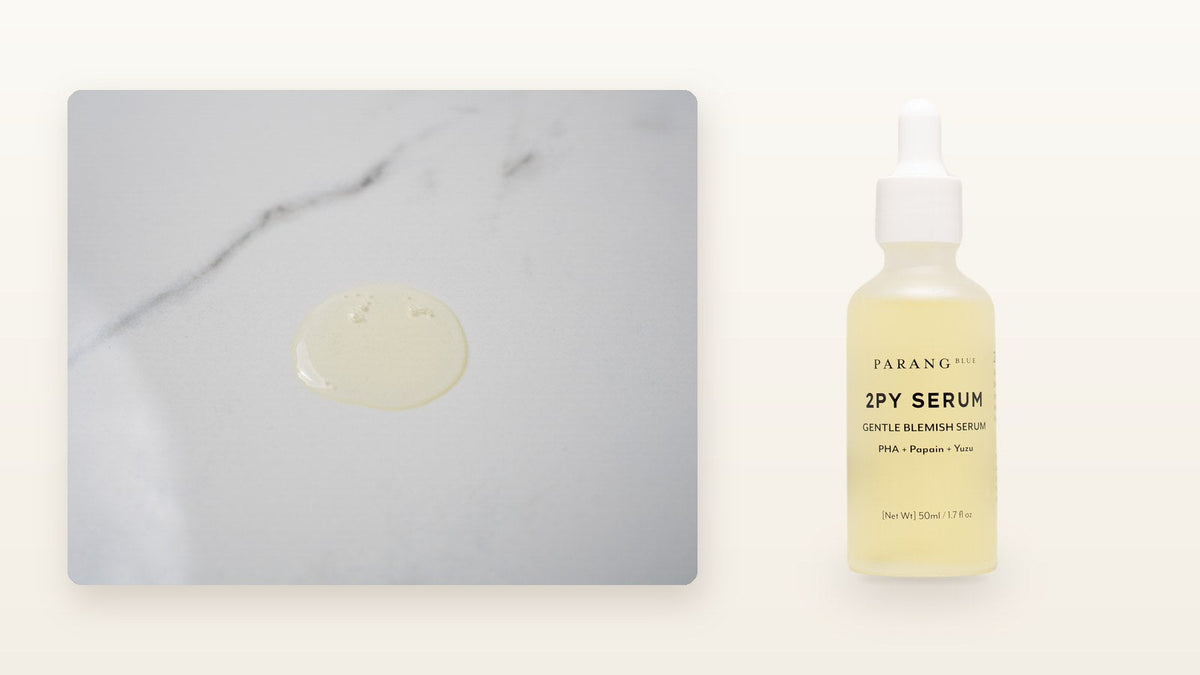
Papain is an enzyme that comes from papaya. Yuzu is a citrus fruit grown in Korea and Japan. In the 2PY Serum, both sit alongside PHA on the exfoliating side of the formula: papain breaks down the proteins that hold dull surface cells in place, and yuzu extract rounds out that work. Together with PHA, they are the three ingredients the serum is built around.
We covered PHA in detail in What PHA Is, and Why It Was Chosen. This post is about the other two.
Papain, the papaya enzyme
An enzyme is a protein that speeds up a specific reaction. Papain's specialty is breaking down other proteins. In skincare, that makes it useful at the surface, where dull, dead cells are held in place partly by protein bonds.
This is a different principle from an acid. PHA loosens surface cells through its acidity. Papain works on the proteins themselves. Two different mechanisms aimed at the same job means each one can do a smaller share.
That is the core reason a papaya enzyme serum can be gentler than a single-acid serum doing the same work alone. It is not that enzymes are magic. It is that splitting a job lets each ingredient sit at a lower level.
| PHA | Papain | |
|---|---|---|
| What it is | A polyhydroxy acid | An enzyme from papaya |
| How it works | Loosens dead surface cells | Breaks down the proteins holding dull surface cells in place |
| Role in the 2PY Serum | Does the main exfoliating work | Shares the work on a different principle |
Yuzu, the citrus
Yuzu is an East Asian citrus, used widely in Korean and Japanese cooking. In the 2PY Serum, yuzu extract supports the exfoliating side of the formula alongside PHA and papain.
It also does something no other ingredient in the bottle does: it gives the serum its faint natural scent. The 2PY Serum has no added fragrance. What you may notice when you open it is the yuzu extract itself, which is in the formula for its own sake. Nothing has been layered on top to cover a base smell.
That distinction matters for people with reactive skin. Many people who react to products learn to sniff a bottle before they read it, because a strong scent is often the first warning sign. Added fragrance is one of the most common reasons a product gets abandoned. A trace of scent from a functional ingredient is a different thing from a perfume blend added to make a product smell a certain way.
Why three ingredients instead of one
Most exfoliating serums pick one star ingredient and turn it up. The 2PY Serum uses three moderate ones instead.
- PHA carries the main load, with a slow, gradual action at the surface.
- Papain works on the protein bonds, a separate route to the same result.
- Yuzu rounds out the exfoliating side and is the only source of scent.
Sharing the work means none of the three has to be present at a high level on its own. That is the design idea that makes a twice-daily exfoliating serum possible for skin that usually cannot handle exfoliation at all.
The other half of the formula is the calming half: centella, madecassoside and asiaticoside, with allantoin, aloe, panthenol and five peptides. The 2PY Serum overview lists all of it.
Reading "papaya enzyme" on other labels
Papain shows up in a lot of products now, from cleansing powders to masks to serums. If you are comparing labels, a few questions help:
- Where does it sit on the list? An ingredient near the end of a long list is often there in a small amount. Order matters more than presence.
- Is it working alone or with others? A single enzyme turned up high is a different design from an enzyme sharing the job with a gentle acid.
- What sits next to it? An exfoliating formula with nothing calming alongside it asks more of your skin.
- Has anything been added for scent? Fruit names on a label can come with a fragrance blend attached. In the 2PY Serum, the yuzu extract is the only scent, and no fragrance has been added.
Asking them takes a minute, and it can save you a week of finding out the hard way. None of these questions tells you how a product will behave on your skin. They do tell you how it was put together, which is usually the most useful thing a label can offer.
How to tell if it suits you
Every skin is its own case, so start slow.
- Try a small amount on a small area first and wait.
- If your skin has been reactive lately, use the serum every other night for the first week.
- Two or three drops, pressed in rather than rubbed.
- Follow with a moisturizer while the serum is still slightly damp.
The 2PY Serum scored 0.00 in a primary skin irritation patch test (Finn Chamber, 24-hour occlusion, read by a dermatologist; Cert. HM-IR0084-76). That is a result on a test panel under controlled conditions, not a prediction about your skin. If anything stings, stop.
Quick answers
What does papain do in skincare?
Papain is an enzyme from papaya that breaks down proteins. In skincare it works at the surface, loosening the protein bonds that hold dull, dead cells in place. In the 2PY Serum it shares that job with PHA and yuzu.
Why does the 2PY Serum smell faintly of citrus?
The faint citrus comes from yuzu extract, which is part of the formula. No fragrance has been added to the serum, so the yuzu is the only scent in the bottle.
Is a papaya enzyme serum gentler than an acid serum?
Not automatically. What makes the 2PY Serum gentle is that papain, PHA and yuzu share the exfoliating work, so none of them has to be present at a high level, and a calming group of cica ingredients sits alongside them.
Try it
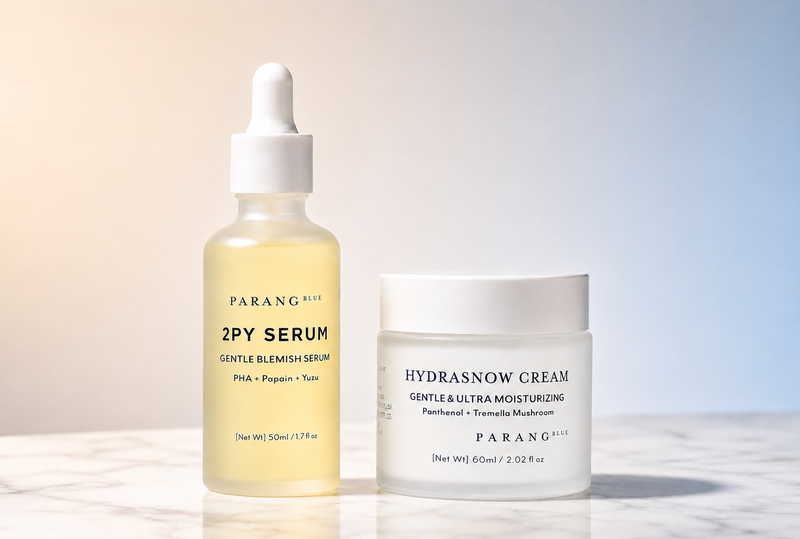
The 2PY Serum is $19.95 for 50 ml. Pair it with the Hydrasnow Cream in The Two-Step Set for $35.90.